France Rail Travel: Network, Operators and Journey Planning
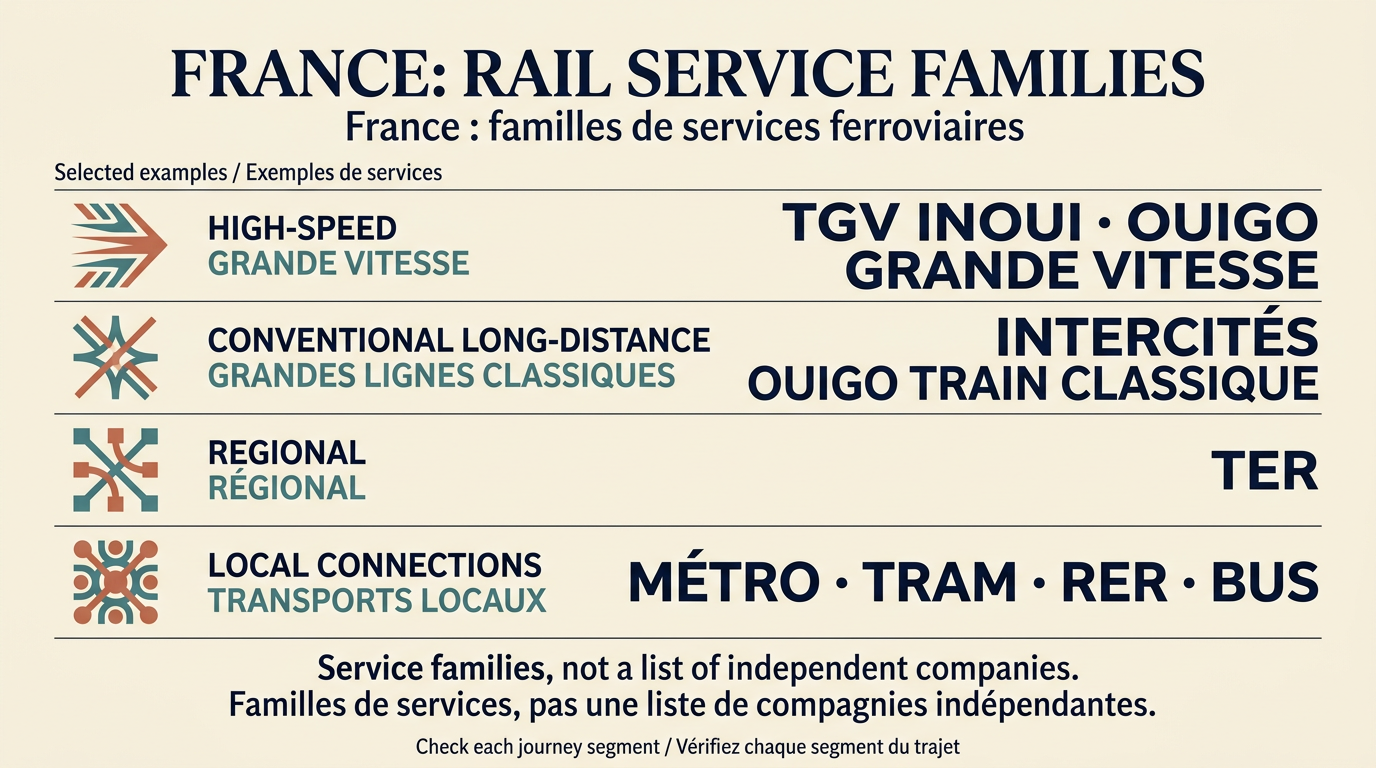
Selected service families: high-speed TGV INOUI and OUIGO Grande Vitesse; conventional long-distance INTERCITÉS and OUIGO Train Classique; regional TER; and local connections. These are examples, not a geographic map or a required journey sequence. Service brands are not a list of independent railway companies; verify the carrier, product and ticket rules for each segment. SNCF TER · INTERCITÉS · OUIGO
France has a layered rail network that combines high-speed, intercity, regional and urban services. For a first trip, the most important planning task is not memorising every train brand: it is confirming the exact stations, operator, departure time and conditions attached to the journey you select.
Planning note: France Rails brings together French rail timetables, station guidance and fare information to help travellers compare journeys. Check the selected service's current conditions before confirming a trip.
How the French rail network fits together
Long-distance journeys may use high-speed services, conventional intercity trains or a combination of long-distance and regional trains. Regional services connect smaller cities and towns with larger hubs, while local metro, tram, RER and bus networks handle the final part of many trips. The service shown in a search result determines which operator rules apply.
Main service families
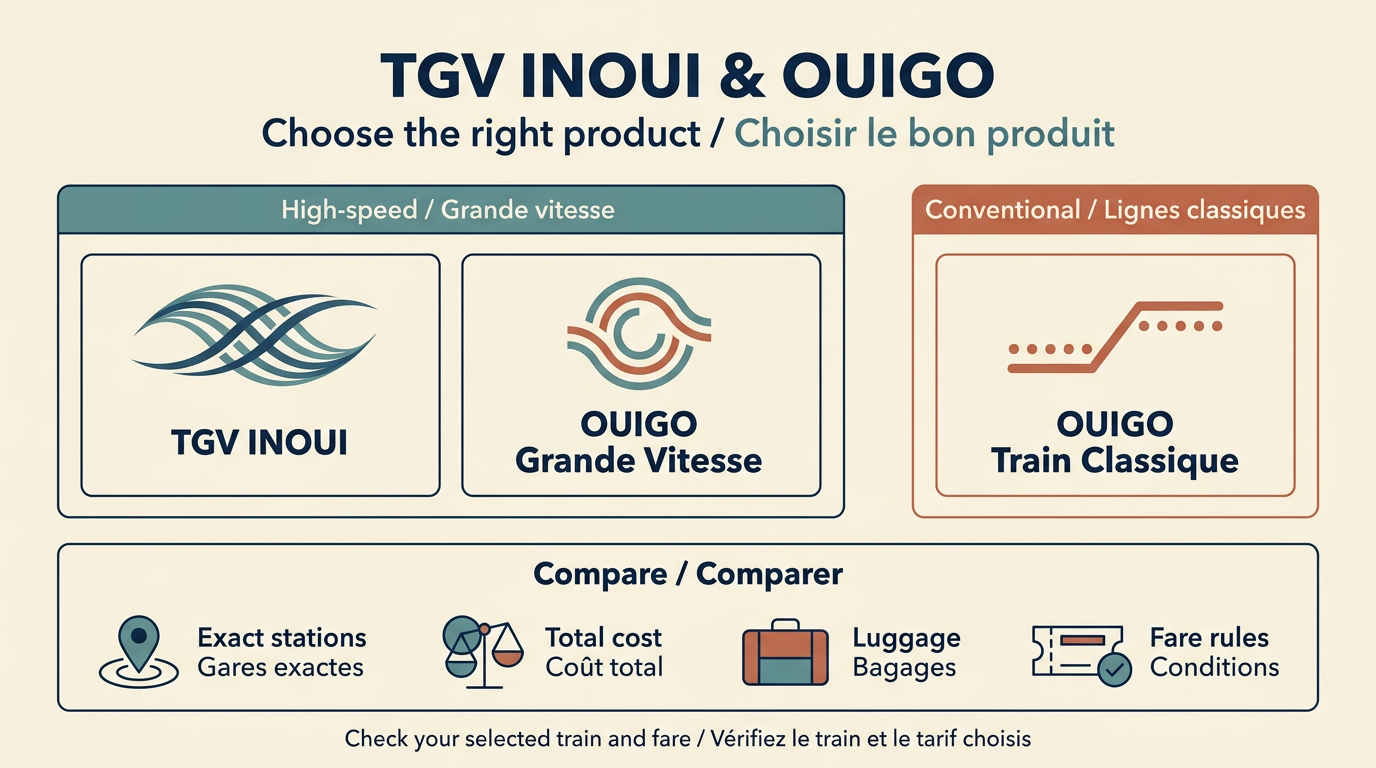
- TGV INOUI: a high-speed service brand used on many domestic and international routes.
- OUIGO: a separate service offer with its own included services and conditions. Check the exact station and fare conditions before choosing it.
- Intercites: conventional long-distance services on selected corridors, including some overnight services.
- TER: regional services whose timetables and commercial conditions can vary by region.
- Other operators: some domestic and international journeys involve operators other than SNCF Voyageurs. Their own conditions govern the relevant segment.
Service names describe different products, not a single universal ticket rule. Luggage, exchanges, refunds, bicycles, pets, boarding procedures and passenger assistance should always be checked for the selected train and fare.
Start with the exact station
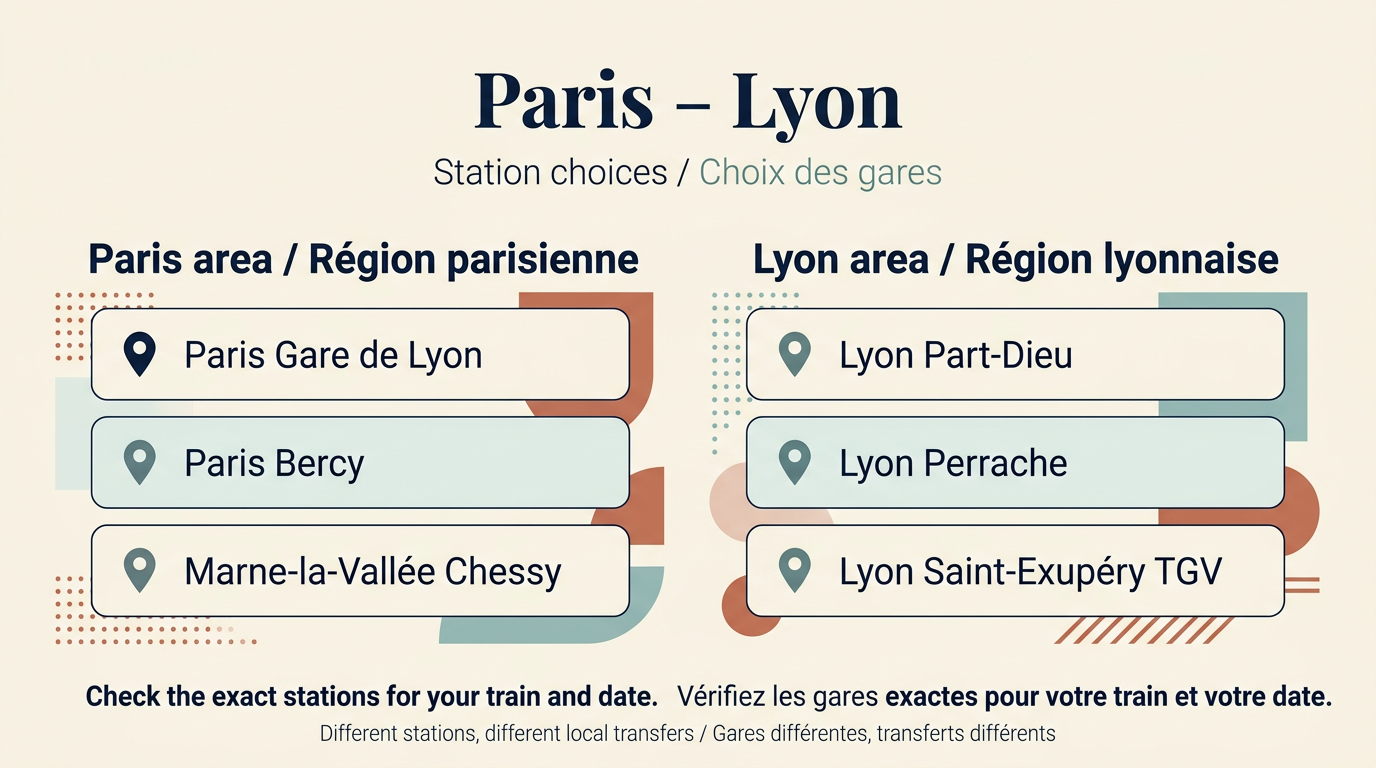
Large French cities often have more than one station. In Paris, long-distance trains use several separate termini, including Gare du Nord, Gare de l'Est, Gare de Lyon, Gare Montparnasse, Gare d'Austerlitz and Gare Saint-Lazare. Lyon also has several useful stations, including Part-Dieu, Perrache and the airport station at Saint-Exupery.
Never plan from the city name alone. Record the full origin and destination station names, then check the time needed to reach each station. A cheaper or faster-looking train can be less convenient if it uses a station far from your accommodation or onward connection.
A practical journey-planning sequence
- Choose exact stations. Check whether your city has multiple terminals and identify the local transport connection you need.
- Compare complete itineraries. Look at departure and arrival time, total duration, number of changes and transfer stations.
- Check the operator. The operator and fare determine the current luggage, exchange, refund and boarding conditions.
- Allow a realistic transfer. Consider platform changes, lifts, walking distance and the consequences of travelling on separate tickets.
- Verify before travel. Recheck the selected service on the operator's official channel and follow station displays on the day.
How to read timetable results
A timetable result should show the departure and arrival station, local times, journey duration and number of changes. For an itinerary with a transfer, expand the result and inspect every segment. A short total duration is not useful if the connection is impractical for your mobility or luggage needs.
Platforms can change and may be announced close to departure. Treat advance platform information as provisional and follow station displays and operator alerts.
Fares and ticket conditions
French rail fares are not governed by one universal flexibility rule. Prices and conditions can vary by service, route, date, demand and fare type. Fare information can help with early planning, while availability and final prices may change by departure and fare conditions.
Before paying through an operator or authorised retailer, read the conditions shown for that specific offer. In particular, check the train, date, passenger details, exchange and refund terms, included luggage and any separate reservation requirement.
Accessibility and assisted travel
Assistance arrangements depend on the station, train and operator. Travellers who need step-free access, boarding assistance or a wheelchair space should consult the official accessibility information early and request any required assistance through the operator. Do not assume that two trains on the same route have identical facilities.
Service brands are not separate operators
TGV INOUI, OUIGO, INTERCITÉS and TER describe service families; do not treat each as an independent railway company. OUIGO Grande Vitesse and OUIGO Train Classique are different products. Read the actual carrier and product on every segment, particularly when comparing domestic and international journeys.
France Rails is an independent journey-planning service. Online booking and ticket issuance are not available here. Verify departures and final fares with your chosen operator or ticket seller.
Continue planning
- High-Speed Trains in France: TGV INOUI and OUIGO Explained
- Paris to Lyon by Train: Times, Stations and Journey Guide
- France Rail Pass Guide: Coverage, Seats and Ticket Comparison
Sources and verification
Editorial check: 11 October 2026. Timetables, fares and conditions can change.